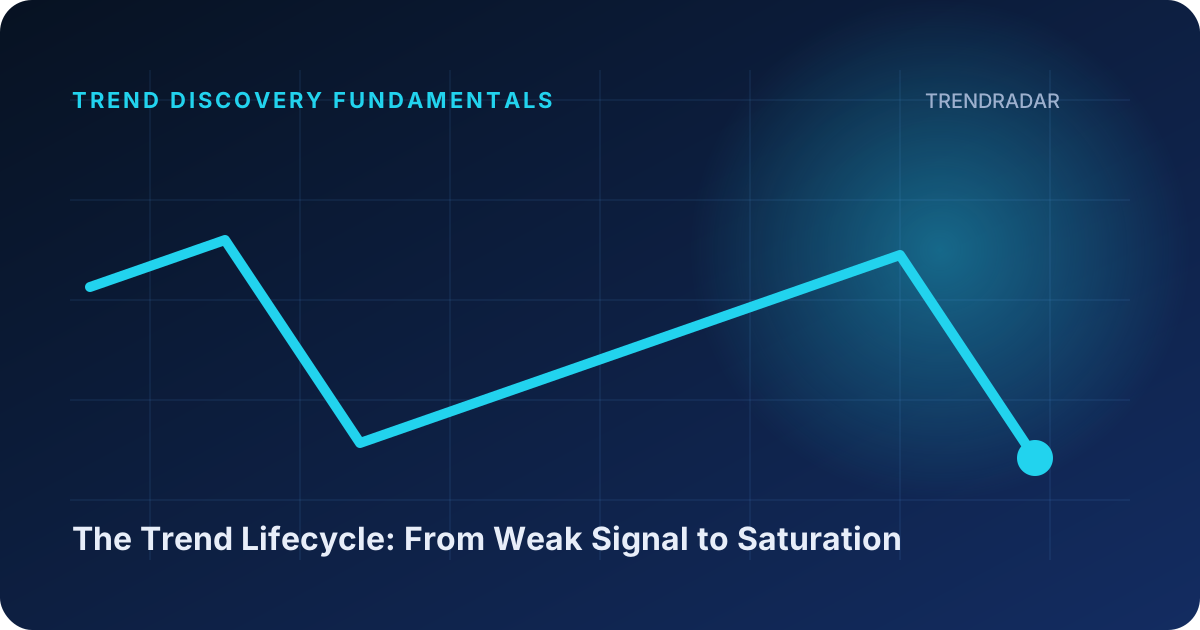
Most online trends pass through a recognisable sequence of stages. Knowing which stage a topic is in matters more than knowing its size, because the right action changes at each stage. The same idea that rewards a quick explainer in week one may need a deep comparison, a local angle or nothing at all by week four.
The lifecycle is a model, not a law. Real attention is uneven: trends pause, return, split into subtrends or skip stages. Use the stages to ask better questions, not to predict exact dates.
Stage 1: Discovery
What it looks like: a small community starts repeating a phrase, format, product or idea. Volumes are tiny and the topic is not on general trending lists.
Signals: new vocabulary in niche forums or comments; a few small creators trying the same thing independently; breakout related queries in Google Trends for a new term.
What to do: watch and record. Early content here is risky because the idea may vanish, but a short, accurate explainer can position you as an early reference if it takes off.
Stage 2: Acceleration
What it looks like: attention grows faster than the topic's usual baseline. More creators join, searches climb and the topic starts appearing in country-level lists.
Signals: the growth rate is increasing from one check to the next; related queries multiply; it begins appearing in more than one country or category.
What to do: this is usually the best window for timely content. Answer the obvious questions clearly and quickly, such as what it is, why it is happening and how to take part.
Stage 3: Adoption
What it looks like: the topic crosses into adjacent audiences. Mainstream media, brands and large creators pick it up. Most people interested in the area have heard of it.
Signals: high volume, but growth slowing; the topic appears on general trending lists across several countries; brand accounts join in.
What to do: basic explainers are now crowded. Differentiate through depth, comparison, testing, local relevance or a clear point of view.
Stage 4: Saturation
What it looks like: participation continues, but new contributions look interchangeable. Audiences start joking about overuse.
Signals: repetitive formats; flattening or falling growth; engagement concentrated on established examples; fewer unanswered questions. Read trend saturation for a fuller checklist.
What to do: stop producing standard versions. Retrospectives, "why it worked" analysis or a deliberate pass are usually better choices.
Stage 5: Decline or renewal
What it looks like: attention falls back. It might return to the old baseline (a fad), settle at a new higher baseline (a lasting shift) or reappear later in a new form.
Signals: declining searches and posts; a stable post-peak level; revivals triggered by anniversaries, sequels or remixes.
What to do: if interest settled higher, update durable evergreen content. If it returned to baseline, archive it and note what you learned.
How to tell which stage you are in
Compare two readings a meaningful interval apart, such as a day for fast topics or a week for slower ones, and ask:
- Who is participating now compared with before?
- Is growth speeding up, steady or slowing?
- Are new audiences or countries arriving?
- Are original angles becoming scarce?
Speed matters more than size here. A large topic with slowing growth is usually later in its lifecycle than a smaller topic that is accelerating. See trend momentum explained.
A common pattern in sound-led trends
Many audio trends follow this shape: a sound starts with a handful of creators, accelerates through remixes and variations, is adopted by brand accounts, saturates when every version looks alike, and sometimes returns months later attached to a new format. The return is a renewal, not a continuation, and it often reaches a different audience.
Mistakes to avoid
- Assuming a smooth bell curve. Real trends stall, jump and revive.
- Judging stage by volume alone. Big does not mean early.
- Using the same content type at every stage. The audience's question changes as the trend matures.
Where TrendRadar fits
TrendRadar shows rising topics by country with their recent movement, which helps you judge whether something is accelerating or already slowing. For telling lasting change from short bursts, read trends vs fads. For how trends start, see how social media trends start and spread.
Free on iPhone and Android
Track where a topic sits in its lifecycle
TrendRadar shows rising Google searches, YouTube videos and music charts for more than 100 countries, with a plain-language explanation of why each topic is moving.